Main article: Architecture of Houston
See also: List of tallest buildings in Houston
Houston has the fourth-tallest skyline in North America (after New York City, Chicago, and Toronto) and 12th-tallest in the world, as of 2014.[74][75][76] A seven-mile (11 km) system of tunnels and skywalks
links downtown buildings containing shops and restaurants, enabling
pedestrians to avoid summer heat and rain while walking between
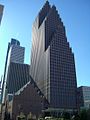
buildings.In the 1960s, Downtown Houston consisted of a collection of midrise office structures. Downtown was on the threshold of an energy industry–led boom in 1970. A succession of skyscrapers was built throughout the 1970s—many by real estate developer Gerald D. Hines—culminating with Houston's tallest skyscraper, the 75-floor, 1,002-foot (305 m)-tall JPMorgan Chase Tower (formerly the Texas Commerce Tower), completed in 1982. It is the tallest structure in Texas, 15th tallest building in the United States, and the 85th-tallest skyscraper in the world, based on highest architectural feature. In 1983, the 71-floor, 992-foot (302 m)-tall Wells Fargo Plaza (formerly Allied Bank Plaza) was completed, becoming the second-tallest building in Houston and Texas. Based on highest architectural feature, it is the 17th-tallest in the United States and the 95th-tallest in the world. In 2007, downtown Houston had over 43 million square feet (4,000,000 m²) of office space.[77]
Centered on Post Oak Boulevard and Westheimer Road, the Uptown District boomed during the 1970s and early 1980s when a collection of midrise office buildings, hotels, and retail developments appeared along Interstate 610 West. Uptown became one of the most prominent instances of an edge city. The tallest building in Uptown is the 64-floor, 901-foot (275 m)-tall, Philip Johnson and John Burgee designed landmark Williams Tower (known as the Transco Tower until 1999). At the time of construction, it was believed to be the world's tallest skyscraper outside of a central business district. The new 20-story Skanska building[78] and BBVA Compass Plaza[79] are the newest office buildings built in Uptown after 30 years. The Uptown District is also home to buildings designed by noted architects I. M. Pei, César Pelli, and Philip Johnson. In the late 1990s and early 2000s, a mini-boom of midrise and highrise residential tower construction occurred, with several over 30 stories tall.[80][81][82] Since 2000 more than 30 high-rise buildings have gone up in Houston; all told, 72 high-rises tower over the city, which adds up to about 8,300 units.[83] In 2002, Uptown had more than 23 million square feet (2,100,000 m²) of office space with 16 million square feet (1,500,000 m²) of class A office space.[84]
-
 The Niels Esperson Building stood as the tallest building in Houston from 1927 to 1929.
-
 The JPMorgan Chase Tower is the tallest building in Texas and the tallest 5-sided building in the world.
-
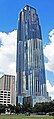 The Williams Tower is the tallest building in the U.S. outside of a central business district.
-
-
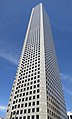 JPMorgan Chase Tower in Houston, Texas is the tallest composite building in the world.


No comments:
Post a Comment